How I Optimize a Google Business Profile Completely, Field by Field
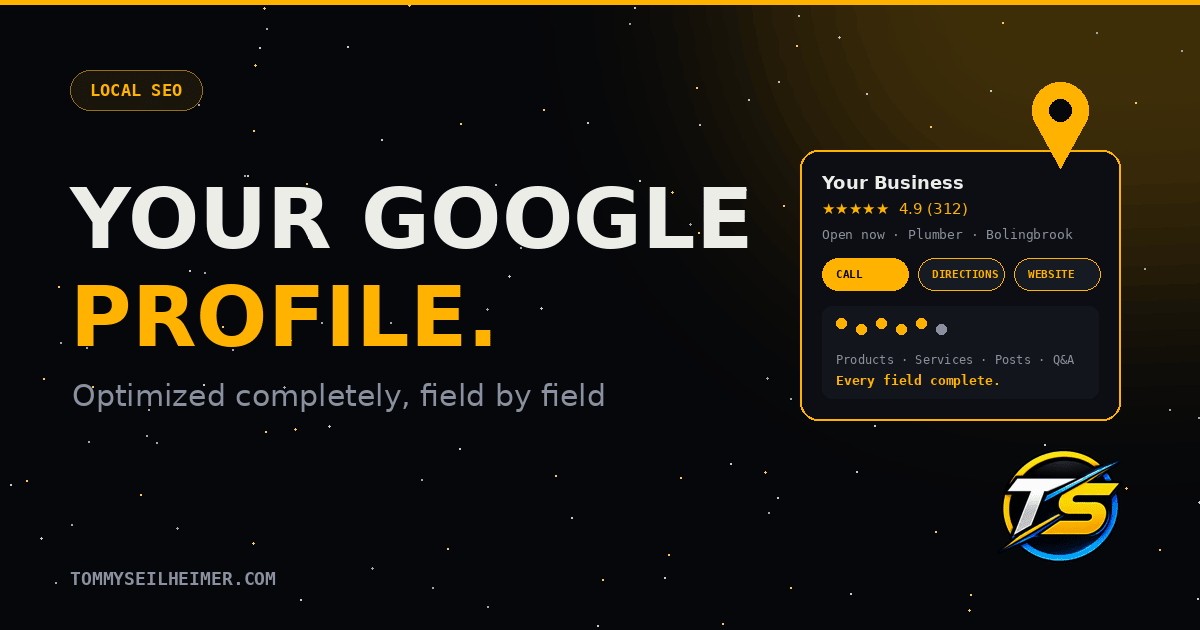
A completely optimized Google Business Profile has the correct primary category, exact and consistent business details, every service and product listed with descriptions, a full description and attributes, a steady flow of real photos and reviews, weekly posts, seeded questions, booking enabled, and a website that says the same things, tracked on a geo-grid so you can see it win. Most profiles have a name, a phone number and a few old photos. That gap is the opportunity.
For a local business the profile decides whether you appear in the Map Pack, the three listings with the map that take the majority of local calls. It matters more than your website for that reason, and it is the highest-leverage asset most owners have never fully built. This is the exact method I use on every Google Business Profile engagement, field by field, with the reasoning. If you want the strategy view first, read how to win the Map Pack in your city. This is the execution.
Why does the profile matter more than your website?
When someone searches for a service near them, Google shows the Map Pack before the organic results, and on a phone it fills the screen. Those three listings get the calls, the direction requests and the tap-to-book actions. The profile is what puts you there. Google’s own guidelines for representing your business spell out what is allowed, and staying inside them while filling every field completely is the entire strategy.
Three factors decide Map Pack rankings: relevance (does your profile match the search), distance (how close you are to the searcher), and prominence (how well known and reviewed you are). You cannot move your building, so the work is relevance and prominence, and almost every field below feeds one or both.
Why is the primary category the most important decision?
The primary category is the main relevance filter Google applies. If it does not match the search, you are often not in the running at all, regardless of everything else. I have moved businesses several Map Pack positions by changing nothing but this field.
The rule: choose the single category that describes your core, highest-value service, using Google’s exact category name. A company that mostly installs roofs is a Roofing Contractor, not a General Contractor. A practice that wants implant patients is a Dental Implants Provider or a Dentist depending on the volume it wants, and that is a strategic choice worth making deliberately. Then add secondary categories for every other real service you offer, and no categories for things you do not do. Wrong or padded categories are the most common reason a smaller competitor outranks a bigger one.
I also check the categories the top three competitors use for your money searches, because Google has already told you what it rewards for that query.
Is your primary category costing you the Map Pack?
I will compare your profile field by field against the businesses holding the top three spots for your money searches and show you exactly what they have that you do not. Free, on a strategy call.
Audit My ProfileHow should the name, address, phone and service area be set?
Name. Your real business name, exactly as it appears on your signage and legal documents. Not “Best Chicago Plumbing Experts 24/7.” Keyword-stuffed names are against the guidelines, competitors report them, and Google suspends them. The short-term boost is not worth the suspension.
Address. A real, staffed location. If you serve customers at their homes and do not have a walk-in location, hide the address and set a service area instead. Virtual offices and PO boxes are a suspension risk.
Service area. The communities you actually serve, listed by name. Setting it does not change rankings by itself, but it tells Google and customers where you work, and it should match the location pages on your site.
Phone. Your primary local number, identical everywhere on the web. Call tracking numbers can be used carefully as the primary with the real number as secondary, but the number on your site, your listings and your profile have to agree.
Hours. Accurate, with special hours for holidays set in advance. “Might be closed” labels appear on profiles with stale hours and they cost calls.
How do the services and products fields drive rankings?
The services section is where relevance gets built out. Every service you offer, listed individually, with a description for each, using the words customers search. Google provides suggested services per category and lets you add custom ones. Most profiles list three. A complete one might list thirty, and each one is a relevance match for a search.
The products section is for anything with a name and a price: menu items, product lines, packages, memberships, even service tiers for a service business. Each product gets a photo, a description and a category, and product cards appear directly in the profile. Retailers, restaurants, med spas and anyone with defined packages should fill this completely.
Both sections should mirror your website: every service listed on the profile has a page on the site, and vice versa. That consistency is a trust signal to Google and to AI engines reading both.
What goes in the description and attributes?
Description. Up to 750 characters. The first sentence states what you do and where, plainly, because it is the part most people read. Then what makes you different in concrete terms, the main services, and the areas you serve. No promotions, no URLs, no keyword stuffing. Written like you would explain the business to a neighbor.
Attributes. The checkboxes most owners skip: identifies as women-owned or veteran-owned, wheelchair accessible, online appointments, onsite services, free estimates, emergency service, languages spoken, payment types. Attributes appear as labels on the profile, some are filterable in Maps, and they are increasingly used by AI engines to match specific requests like “emergency plumber that takes credit cards.” Fill every one that is true.
How many photos, what kind, and how often?
Photos drive engagement, and engagement is a prominence signal. The profile needs a logo, a cover photo, exterior shots that help people find you, interior shots, team photos, and above all photos of the work: before and after, finished jobs, real projects in real neighborhoods. Then it needs new ones regularly. A profile that gets fresh photos every couple of weeks looks like an active business, and Google treats it that way.
Two myths to retire. Stock photos hurt more than help; customers recognize them instantly. And geotagging photo files does nothing for rankings. What matters is real photos, uploaded consistently, showing the work you want more of. Short videos, under 30 seconds, of jobs and the team perform especially well and almost nobody posts them.
How do I build a review system that Google rewards?
Reviews are the biggest prominence lever you control, and Google reads the text, not just the stars. What works is a system, not a plea:
- Ask every customer, every time, at the moment of highest satisfaction, with a direct link to the review form. Automate the ask by text or email within 24 hours of the job.
- Guide the content without scripting it. A prompt like “it helps other homeowners if you mention the service and your neighborhood” produces reviews that say “great furnace install in Lisle.” Those words are relevance signals.
- Never gate reviews by asking happy customers to post publicly and unhappy ones to contact you privately. It is against the guidelines and it gets caught.
- Reply to every review, good and bad, within a day or two, mentioning the service. Replies are content Google reads, and they show prospects how you treat people.
- Aim for steady velocity rather than a burst. Ten reviews a month for a year beats a hundred in one week, which looks bought.
Protecting what you build matters too. Fake negative reviews, competitor attacks and review removal are their own discipline, which is why I run the GBP Reputation Shield for clients who have been targeted.
Key takeaways
- The primary category is the single most important field. Get it right before anything else.
- Your name, address and phone must be real, compliant and identical everywhere on the web.
- List every service and product individually. Each one is a relevance match.
- Reviews are a system: ask every customer, guide the content, reply to all, keep a steady pace.
- Fresh real photos, weekly posts and seeded Q&A keep the profile active in Google’s eyes.
- Track on a geo-grid. One rank check from one spot is not data.
Do Google Posts and Q&A still matter?
Yes. Google Posts appear on the profile and in some Map Pack results, and consistent posting is an activity signal. One post a week is enough: a completed job with a photo, an offer, a seasonal tip, an answer to a common question, each with a call to action. Posts expire from the main view after a week, which is exactly why the cadence matters.
The Q&A section is public and anyone can ask or answer, including competitors. So I seed it: the eight to ten questions customers ask before hiring, asked and answered from the business account, with the answers written the way the services and description are written. Then I monitor it, because an unanswered question on your profile reads as neglect.
Booking, messaging, hours and the website link
Booking. If customers can schedule online, connect the booking provider or add the appointment link so the Book button appears. It converts profile views directly into appointments without a website visit.
Messaging. Turn it on only if someone will answer within minutes during business hours. Google shows response times, and slow responses hurt more than no button.
Website link. Point it at the most relevant page, which for a single-location business is usually the homepage, and add tracking parameters so you can see profile traffic separately in analytics. For multi-location businesses each profile links to its own location page.
Opening date, accessibility, amenities. Small fields, all filled, all part of the completeness score that separates a serious profile from a claimed one.
How do citations and the website connect to the profile?
The profile does not exist in isolation. Google checks it against the rest of the web, and inconsistency erodes trust.
Citations. Your name, address and phone on the directories and platforms that matter for your industry and city, identical to the character. Old addresses, former phone numbers and misspelled names on stray listings are cleaned up or removed. This is unglamorous and it moves rankings.
The website. The page your profile links to should carry the same name, address, phone and hours, an embedded map, and LocalBusiness schema that states them for machines. The services on the profile should exist as pages. The location pages for your service area should match the service area on the profile. When the site and the profile tell the same story in the same words, Google trusts both. That is the whole reason I optimize the profile and the site’s SEO together, and why a clean, fast website is part of local rankings, not separate from them.
Where do you actually rank across town?
A geo-grid tells the truth a single rank check hides. I will run one for your business, show you the neighborhoods you win and lose, and explain what would change the picture.
Show Me My Geo-GridHow do I deal with competitor spam and fake listings?
In competitive categories a real share of the profiles above you are breaking the rules: keyword-stuffed names, fake addresses, lead-generation shells with no real location, duplicate listings. Google removes them when they are reported properly, and every removed spam listing moves you up.
The process is suggesting an edit on the offending profile with evidence, and for persistent cases using Google’s business redressal form with documentation. It is tedious and it works. I audit the top competitors for every client during the first month, because clearing two spam listings can do more than six months of content.
How do I track whether it is working?
A single rank check from your office tells you nothing about a dense market, because the Map Pack changes block by block. I track every profile on a geo-grid: a grid of points across the service area, each checked for your position, shown as a color map. You see the neighborhoods where you hold the top three and the ones where you fade, and the map changes month to month as the work lands.
Alongside it: profile views, searches that surfaced the profile, calls, direction requests and website clicks from the profile itself, and the leads they became. It all goes into the monthly video walkthrough that is part of my reporting, so you can see the profile earning its keep. You can see what that looks like on my results page.
What if the profile gets suspended?
Suspensions happen, usually for a name that broke the rules, an address Google could not verify, a category change that triggered a re-review, or too many edits in a short window. The profile disappears from Maps and the calls stop the same day.
The fix is finding the actual cause, correcting the profile so it is fully compliant, assembling the documentation Google requires to prove the business is real and at that address, and managing the appeal until it is restored. It is a specialty, and one I handle regularly as GBP reinstatement. The best protection is everything above: a profile built inside the guidelines from the start rarely gets suspended.
Every field in this guide is available in my FAQ center as a quick answer, and I work on profiles for businesses across my entire service area and nationwide.
Ready to build the profile that wins the map?
Every field in this guide is something I do for clients, in this order, tracked on a geo-grid so you can watch it work. Book a free strategy call and I will show you where your profile stands today.
Book My Free Strategy CallFrequently asked questions
What is the most important field on a Google Business Profile?
Can I add keywords to my business name?
How many photos should a Google Business Profile have?
Do Google Posts help rankings?
How do I get more Google reviews?
What is a geo-grid rank tracker?
Should I hide my address?
Why was my Google Business Profile suspended?
Where to go next.
Search visibility is one system. These guides cover the rest of it.
 SEO
The SEO Foundation Every Business Needs in 2026
Read this next if you want the short version of what has to be true before any of this works.
Read the guide → AI Search
GEO vs AEO: How to Get Cited by ChatGPT and Gemini
Read this next if you want to understand how AI answers choose their sources, and why a citation beats a ranking.
Read the guide → Local SEO
How to Win the Google Map Pack in Your City
Read this next if you serve a local area and the Map Pack is where your calls come from.
Read the guide → SEO
What SEO Actually Involves: A Deep Dive Into How I Rank a Business
Read this next if you want the full SEO process, step by step, in the order I actually run it.
Read the guide → AI Search
Generative Engine Optimization: How I Use EZY.ai to Get Your Business Cited by AI
Read this next if you want AI visibility measured and moved month by month, with screenshots.
Read the guide → Video
YouTube SEO: How I Grew a Channel Past 243,000 Subscribers, and How Video Ranks Your Business
Read this next if you want the playbook that grew a channel past 243,000 subscribers, applied to your business.
Read the guide → Reputation
Google Reviews and Reputation: The Complete Playbook, Including How Fake Reviews Get Removed
Read this next if reviews are your tiebreaker and you want the system that earns and protects them.
Read the guide → Reporting
How to Read an SEO Report: The Metrics That Prove Leads, and the Ones That Lie
Read this next if you cannot say what your SEO did last month, and you want a report that proves it.
Read the guide → Consulting
Should You Hire an SEO Agency or Train Your Own Team? The Consulting Model, Explained
Read this next if you have a marketing team and want the method installed inside it.
Read the guide →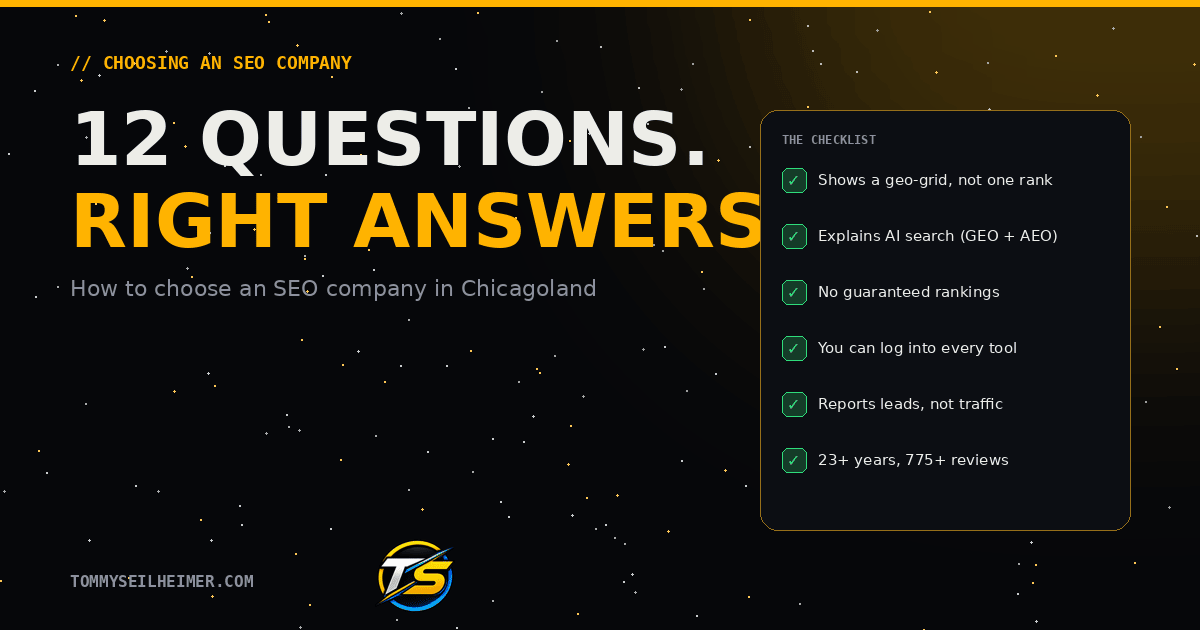 Choosing an Agency
How to Choose an SEO Company in Chicagoland: 12 Questions to Ask, and the Answers That Tell You Everything
Read this next if you are comparing SEO companies and want the questions that reveal which one will actually grow your business.
Read the guide →