Generative Engine Optimization: How I Use EZY.ai to Get Your Business Cited by AI
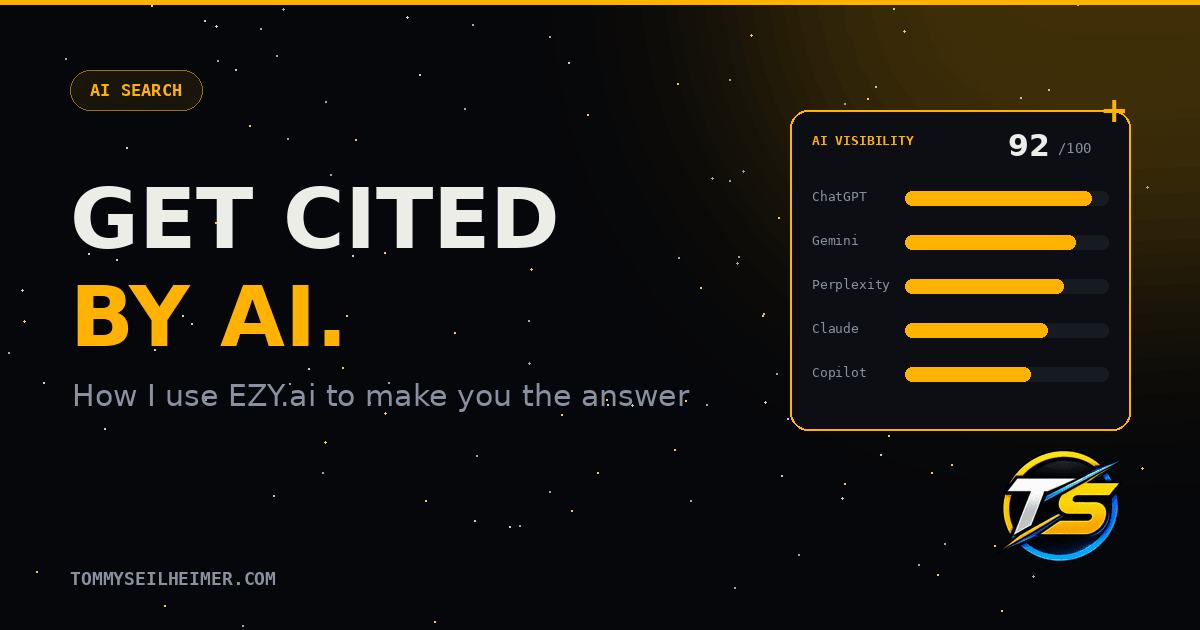
Generative engine optimization is the work of getting your business named and cited when someone asks ChatGPT, Gemini, Claude or Perplexity who to hire, and EZY.ai is the platform I use to measure it, because you cannot optimize what you cannot see. AI answers are different for every person, every session and every engine, so guessing whether you show up is worthless. Tracking it is the whole game.
This article explains exactly how I run GEO as a managed service: what EZY.ai tracks, how I build the prompt set and knowledge base, how I read the gap report, what gets changed on and off your site, and what the monthly loop looks like. If you have read my comparison of GEO and AEO, this is the operational sequel.
One framing before we start. AI engines do not rank ten results. They recommend two to seven businesses and cite the sources that convinced them. In a market with hundreds of competitors per category, being one of those few is the biggest visibility advantage available right now, and almost nobody is working for it.
What is generative engine optimization?
GEO is optimization aimed at generative engines: large language models that answer questions in sentences and recommend specific businesses. When a homeowner in Naperville asks ChatGPT for a reliable furnace repair company, the engine runs searches, reads a set of pages, weighs which businesses are corroborated across trusted sources, and names a few. GEO is the work of becoming one of the named few, consistently, across engines.
It rests on three things: clarity (machines can extract exactly what you do and where), corroboration (other trusted sources say the same thing about you), and measurement (you know which prompts name you and which name your competitors). Most businesses have done nothing on any of the three. Google’s own guidance on AI features confirms there is no special trick; the same quality and structure signals apply, just with far fewer winners per answer.
Why do you need a platform to do GEO at all?
Here is the problem with doing GEO by hand. You ask ChatGPT a question and it names three businesses. Your competitor asks the same question from a different account and gets a different three. Gemini gives a fourth list. Perplexity a fifth. Ask again next week and the answers have moved. Any single check is an anecdote, and you cannot run a strategy on anecdotes.
GEO needs what SEO has had for twenty years: a rank tracker. A fixed set of realistic customer prompts, run on a schedule, across every major engine, with the results stored so you can see trends, share of voice against competitors, and which sources the engines are citing. That is what a platform provides, and it is why I stopped doing spot checks and built the service around EZY.ai.
What is EZY.ai and what does it track?
EZY.ai is an AI visibility platform. I use it to track, at the level of individual prompts, whether a business is mentioned and cited across the engines that matter. What it measures for each client:
| What EZY.ai tracks | Why it matters |
|---|---|
| Mentions by prompt and engine | Whether ChatGPT, Gemini, Claude, Perplexity and Copilot name you for each real customer question. |
| Citations and cited sources | Which pages and domains the engines are pulling from when they answer. This is the map of where you need presence. |
| Share of voice | Your mention rate against named competitors across the whole prompt set. The single number that shows whether GEO is working. |
| Sentiment and context | How you are described when you are mentioned. Being named as “a budget option” is not the same as “the top-rated choice.” |
| Trends over time | Month-over-month movement per prompt, per engine, so wins and losses are visible and attributable. |
I sell this as a managed service under my own brand. The platform is one part of it. The monthly optimization work is the part that moves the numbers, and the report clients receive is white-labeled as their AI Visibility Report. You get the data and the work, not a login and a manual.
Does ChatGPT name your business today?
Most owners have never checked, and the answer usually stings. On a free strategy call I will run your real customer questions across the major engines, show you who gets named instead, and explain what it takes to change it.
Run My AI BaselineStep 1: build the prompt set and the baseline
Everything starts with the prompt set. These are not keywords. They are the full questions your customers actually type into an AI assistant, and they need to be realistic, specific and local. For an HVAC company that might be “who is the best furnace repair company in Downers Grove,” “is it worth replacing a 15 year old furnace,” “emergency AC repair near Naperville that is open on weekends,” and “what should a new furnace cost in the Chicago suburbs.”
I build 30 to 100 prompts per client across three types: recommendation prompts (who should I hire), comparison prompts (what does it cost, what is better), and research prompts (how does this work, what should I know). Each gets local modifiers for the communities you actually serve. Then EZY.ai runs the full set across every engine and records the baseline: who is named, who is cited, and where you stand. For most new clients the baseline is zero mentions on recommendation prompts. That number is the starting line, and it is why measuring first matters.
Step 2: build the knowledge base, everything AI needs to know
An AI engine can only recommend what it understands, and most businesses have never told the internet, clearly and consistently, what they do. So the second step is building the knowledge base: the complete, consistent set of facts about your business that AI needs in order to recommend you with confidence.
That means every service, described the way a customer would ask for it. Every community you serve. Your credentials, years in business, guarantees, hours, pricing ranges where you can state them, what makes you different in concrete terms, and your proof: reviews, results, awards, partnerships. The answers to the questions customers ask before hiring. All of it written once, kept consistent everywhere it appears, and refreshed monthly as the business changes.
This knowledge base drives everything downstream. It becomes the content on your service and location pages, the FAQ content with schema, the llms.txt file that hands AI crawlers a clean summary of your business, and the facts I push out to the off-site sources engines trust. It is the reason the managed service is worth more than the software alone: the knowledge base is the part that has to be built and maintained by a person who understands your business and the machines reading about it.
Step 3: read the gap report
With the baseline and knowledge base in place, the gap report answers the two questions that decide the strategy. Who is being named instead of you, prompt by prompt, and which sources convinced the engine to name them.
The second question is the goldmine. When EZY.ai shows that Gemini cites a particular directory, a local news site, a review platform and a competitor’s FAQ page for a given prompt, I know exactly where presence needs to be earned. Sometimes it is a directory you are not listed in. Sometimes it is a review site where a competitor has 200 reviews and you have 12. Sometimes it is a question the competitor answers on their site and you do not. The report turns GEO from guesswork into a checklist.
I also look at the sentiment data here. If you are being mentioned but described weakly, that points to the language on your own site and in your reviews, which is fixable.
Key takeaways
- AI answers name only a few businesses per question, so being cited is worth more than a page-one ranking.
- You cannot optimize what you cannot see. EZY.ai tracks mentions, citations and share of voice per prompt, per engine, monthly.
- The knowledge base, everything AI needs to know about you, is the core asset and it has to be maintained by a person.
- The gap report shows which sources convinced the engines to name competitors. That is your checklist.
- GEO is a monthly loop, not a project, and it sits on top of solid SEO and a complete Google Business Profile.
Step 4: optimize the site for extraction
The on-site work makes your content easy for machines to extract and quote. It overlaps heavily with answer engine optimization, and it is the fastest-moving part of the process:
- Answer-first passages. Under every heading, the answer in the first sentence or two, in a form that can be lifted out of context and still make sense.
- Question-shaped headings that match the prompts in the set. If customers ask “what should a new furnace cost,” a page should answer exactly that, under exactly that heading.
- Entity clarity. Your business name, services, areas and facts identical across the site, the Google Business Profile and every listing. Inconsistency reads as unreliability to a machine.
- Schema. LocalBusiness, Service, FAQPage and Article markup, so the engine does not have to guess what a page is.
- llms.txt and crawler access. A clean summary file for AI crawlers, and a robots file that does not block GPTBot, ClaudeBot, PerplexityBot or Google-Extended. A default robots setting blocking these is the most common self-inflicted wound in this field.
- Freshness. Dates, updated facts, current prices. Engines favor current sources for anything that changes.
Step 5: earn the citations off-site
Engines trust what they can corroborate. The off-site work earns presence in the places the gap report showed the engines reading:
Directories and platforms AI trusts. Complete, consistent listings on the review and directory sites that appear in the cited-sources data, with the same facts as the knowledge base.
Reviews with substance. A steady flow of reviews that mention specific services and neighborhoods. Engines read review text, not just star counts, and a review that says “replaced our furnace in Lisle in one day” is a citation in its own right.
Local press and community presence. Real coverage, sponsorships, association memberships. The same authority work that powers SEO, aimed at the sources engines cite.
Video. AI engines cite YouTube heavily. A short, clear video answering a prompt from the set, with a transcript, is one of the most reliable ways to earn a citation. That is why YouTube SEO is part of the service for clients who will get on camera.
Want to watch the loop run on your business?
I will show you a real AI Visibility Report, walk through a live gap analysis, and give you a straight answer on whether GEO makes sense for your market right now.
Show Me a Real ReportStep 6: the monthly loop and the AI Visibility Report
GEO is not a project. It is a loop, and the loop runs monthly:
- Refresh the knowledge base. New services, new areas, new proof, new answers. Push the changes everywhere they belong.
- Re-run the prompt set across every engine in EZY.ai.
- Compare to last month. Which prompts gained a mention, which lost one, how share of voice moved against each competitor, which new sources are being cited.
- Act on the gaps. Content to publish, listings to fix, reviews to earn, questions to answer.
- Report. The AI Visibility Report, with screenshots of the actual answers naming you, delivered alongside the regular monthly reporting.
Screenshots matter. An owner seeing ChatGPT recommend their business by name, in an answer to a real customer question, understands GEO instantly in a way no chart can achieve.
What results look like
The pattern I see across clients is consistent. Month one, the baseline shows zero or near-zero mentions on recommendation prompts, even for businesses that rank well on Google. Within the first two to three months of the loop, mentions appear on the research and comparison prompts where the answer-first content was built. Recommendation prompts follow as off-site corroboration and reviews accumulate, usually over months three to six. Share of voice against competitors then climbs steadily, and the trend line becomes the proof.
The businesses that move fastest are the ones that already had solid SEO and a complete Google Business Profile, because the engines already trusted them and only needed the structure. That is why I run GEO on top of the fundamentals, never instead of them. You can see documented outcomes on my results page and hear from clients directly in their reviews.
What does managed AI visibility cost?
I offer managed AI visibility at $495 per month. That includes the EZY.ai platform tracking your prompt set across every major engine, the monthly knowledge-base refresh and optimization work, the on-site and off-site changes the gap report calls for, and the white-labeled AI Visibility Report with screenshots. It is designed to sit alongside an SEO or Google Business Profile engagement, and it is month to month.
The honest comparison: the platform on its own is far cheaper, and if you have a marketer on staff who will build the prompt set, maintain the knowledge base and act on the gap report every month, you could run it yourself. The service exists because almost nobody does that consistently, and consistency is what produces the citations.
Does GEO replace SEO?
No. GEO sits on top of SEO. The engines find candidates by searching, so a site that does not rank, cannot be crawled, or has no authority does not get cited no matter how it is structured. The order is always the same: a technically sound site and a complete Google Business Profile, then answer-first structure and schema, then the measured GEO loop. I walk through the foundation in what SEO actually involves, and the profile in how I optimize a Google Business Profile completely. Do those, add this, and you are working on all of the surfaces your customers use at once. You can also browse 500+ answers to questions about every service I offer.
Ready to be the business AI recommends?
The engines are already answering your customers. The only question is whose name they say. Book a free strategy call and I will show you where you stand across ChatGPT, Gemini and the rest, and what it takes to get cited.
Book My Free Strategy CallFrequently asked questions
What is generative engine optimization?
What is EZY.ai?
Why not just ask ChatGPT myself?
What is the knowledge base?
How long does it take to get cited by AI?
What does the managed AI visibility service cost?
Do I need SEO before GEO?
Which AI crawlers should my site allow?
Where to go next.
Search visibility is one system. These guides cover the rest of it.
 SEO
The SEO Foundation Every Business Needs in 2026
Read this next if you want the short version of what has to be true before any of this works.
Read the guide → AI Search
GEO vs AEO: How to Get Cited by ChatGPT and Gemini
Read this next if you want to understand how AI answers choose their sources, and why a citation beats a ranking.
Read the guide → Local SEO
How to Win the Google Map Pack in Your City
Read this next if you serve a local area and the Map Pack is where your calls come from.
Read the guide → SEO
What SEO Actually Involves: A Deep Dive Into How I Rank a Business
Read this next if you want the full SEO process, step by step, in the order I actually run it.
Read the guide → Local SEO
How I Optimize a Google Business Profile Completely, Field by Field
Read this next if your Google profile is half built. This fills every field.
Read the guide → Video
YouTube SEO: How I Grew a Channel Past 243,000 Subscribers, and How Video Ranks Your Business
Read this next if you want the playbook that grew a channel past 243,000 subscribers, applied to your business.
Read the guide → Reputation
Google Reviews and Reputation: The Complete Playbook, Including How Fake Reviews Get Removed
Read this next if reviews are your tiebreaker and you want the system that earns and protects them.
Read the guide →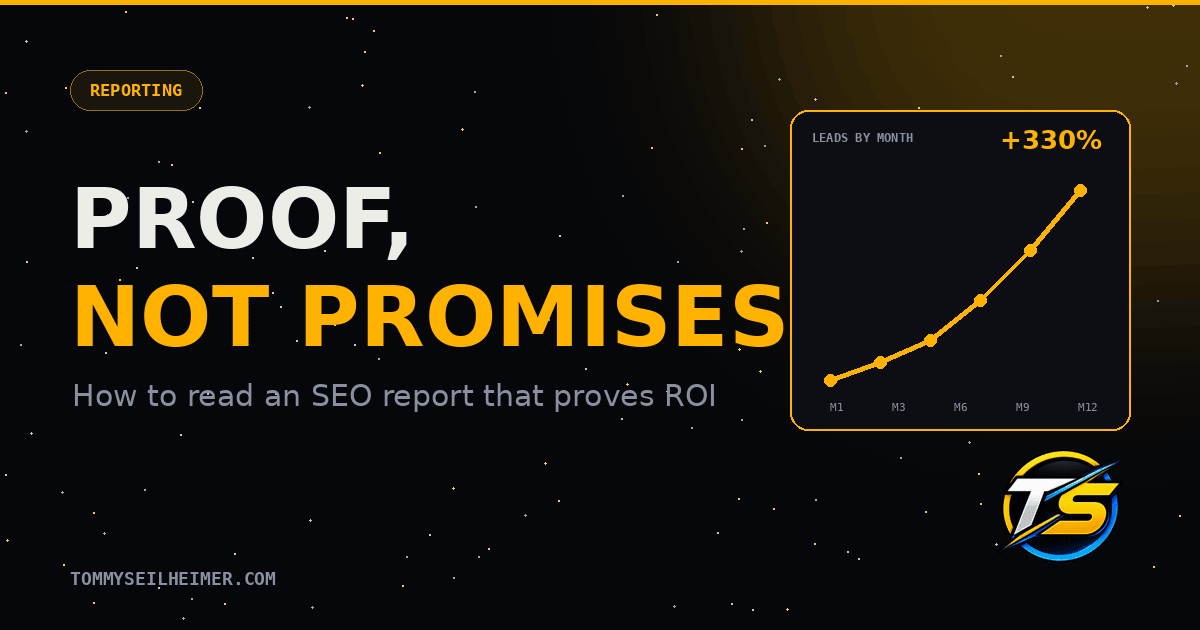 Reporting
How to Read an SEO Report: The Metrics That Prove Leads, and the Ones That Lie
Read this next if you cannot say what your SEO did last month, and you want a report that proves it.
Read the guide →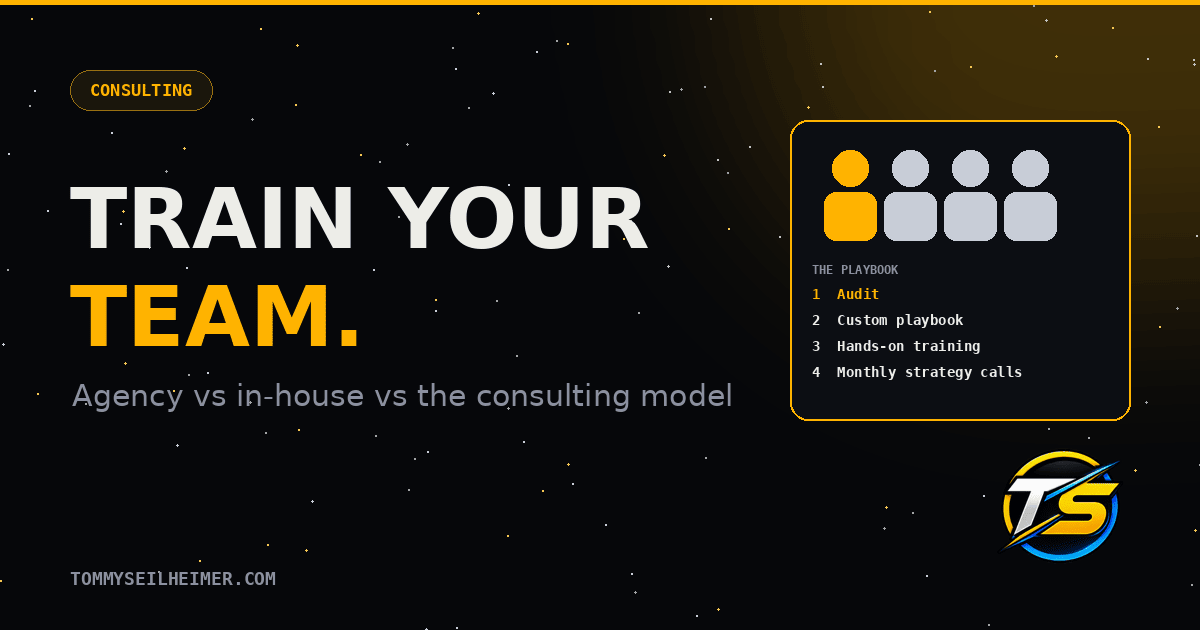 Consulting
Should You Hire an SEO Agency or Train Your Own Team? The Consulting Model, Explained
Read this next if you have a marketing team and want the method installed inside it.
Read the guide →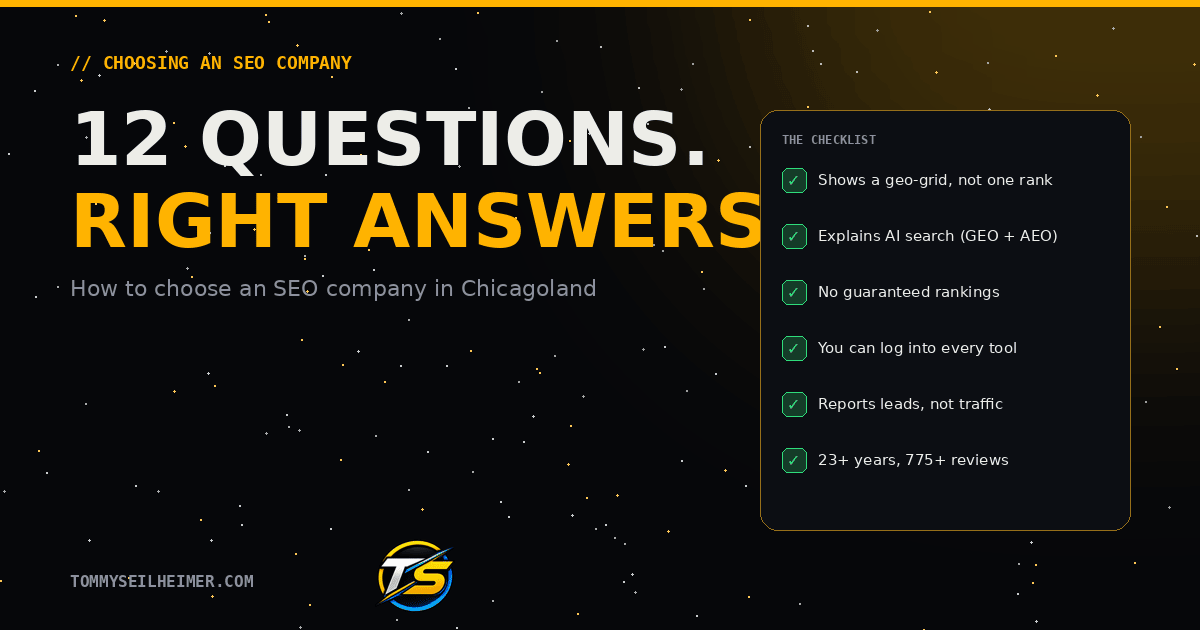 Choosing an Agency
How to Choose an SEO Company in Chicagoland: 12 Questions to Ask, and the Answers That Tell You Everything
Read this next if you are comparing SEO companies and want the questions that reveal which one will actually grow your business.
Read the guide →