GEO vs AEO: How to Get Cited by ChatGPT and Gemini
GEO (Generative Engine Optimization) is the practice of getting your business cited and recommended by AI engines like ChatGPT, Gemini, Perplexity and Google’s AI Overviews. AEO (Answer Engine Optimization) is the practice of owning the direct answer - the featured snippet, the voice result, the response an assistant reads aloud. They overlap heavily, and in 2026 you need both. The goal has shifted from ranking a link to being inside the answer.
Here is why this is urgent. A growing share of buyers now ask ChatGPT or Gemini before they ever open Google. And inside an AI answer there are only a handful of citation slots - often somewhere between two and seven - compared with ten organic results plus ads on a traditional page. The funnel got dramatically narrower. If you are not one of the sources named, you do not exist for that query.
I have spent 23 years getting businesses ranked, and this is the biggest shift I have seen since mobile. This guide is the actual playbook I run for clients.
What is the difference between GEO and AEO?
Think of it this way: AEO makes you the answer - the snippet at the top, the voice result, the fact an assistant states outright. GEO makes you a trusted, cited source that generative engines pull from and recommend by name when someone asks for a solution or a provider.
| AEO | GEO | |
|---|---|---|
| Goal | Own the direct answer | Get cited and recommended as a source |
| Surfaces | Featured snippets, voice, People Also Ask | ChatGPT, Gemini, Perplexity, AI Overviews |
| Wins on | Clear, concise, extractable answers | Authority, corroboration, brand presence |
| Typical query | “What is X?” | “Who is the best X near me?” |
AEO has existed since featured snippets. GEO is the newer layer built for large language models. In practice you optimize for both with the same content - you just structure it so machines can quote it and trust it.
Why getting cited matters now
The scale is real. ChatGPT serves hundreds of millions of weekly users, Gemini is built into Google’s ecosystem and Android, and AI Overviews now appear above the traditional results for a large share of informational searches. Even when the raw referral traffic from these engines is smaller than Google’s, the visitors it does send are unusually high-intent - they arrive already educated and closer to a decision.
There is a second-order effect too. When someone asks an assistant “who should I hire for this,” being named is a recommendation, not just a listing. That carries far more persuasive weight than a blue link, because the user experiences it as advice rather than advertising.
How AI engines actually choose their sources
Understanding the mechanics tells you what to optimize. Broadly, generative engines answer in one of two ways, and often both at once.
Retrieval. The engine runs a live search, pulls a set of candidate pages, and synthesizes an answer from them, citing the ones it used. This is how AI Overviews, Perplexity, and ChatGPT’s browsing mode work. Here, ranking well in the underlying search index is the price of entry - you cannot be retrieved if you are not indexed and competitive.
Training and memory. The model may also draw on patterns absorbed during training - which brands are frequently discussed, in what context, and with what sentiment. You cannot optimize training data directly, but you influence it the same way you build a reputation: by being genuinely, consistently present across the web over time.
The critical detail most people miss: different engines use different indexes. ChatGPT has historically leaned on Bing’s index, while Google’s AI Overviews and Gemini use Google’s, and Perplexity blends its own crawling with third-party sources. The same question can return completely different sources depending on where it is asked. That means “we rank on Google” is no longer a complete visibility strategy - you have to earn presence across engines.
The 9-step playbook to get cited
None of this is magic. It is being clear, quotable, and trusted in ways machines can parse.
- Front-load the answer. Under every heading, state the answer in the first sentence or two - roughly 40 to 60 words, plain declarative language, no wind-up. Engines lift self-contained passages. Bury your answer under three paragraphs of throat-clearing and you will not get pulled.
- Write question-shaped headings. Mirror how people actually ask, then answer immediately underneath. Notice this article is built entirely on question headings - that is deliberate, and it is the single easiest structural change most sites can make.
- Make passages self-contained. Each section should make sense lifted out of context. Avoid “as mentioned above” and vague pronouns; restate the subject so an extracted paragraph still stands on its own.
- Add real specificity. Numbers, dates, named methods, prices, and concrete steps get cited far more than vague claims. “Most clients see movement in three to six months” is quotable. “Results vary” is not.
- Build entity authority off-site. LLMs weigh third-party corroboration heavily. Genuine coverage, industry directories, reviews, podcast appearances, and consistent brand mentions across credible sites make you a source worth naming. Do not manufacture this - fake mentions and link schemes violate Google’s policies and are increasingly easy to detect.
- Strengthen your E-E-A-T. Experience, expertise, authoritativeness, and trust. Real author names with credentials, first-hand experience, visible business details, and honest case studies. Gemini in particular leans on these signals.
- Keep your facts consistent everywhere. If your services, service area, or business details differ between your site, your Google Business Profile, and third-party listings, you look unreliable to a system trying to state facts confidently. Consistency is a trust signal.
- Maintain freshness. Engines favor current information, especially for anything that changes. Update your cornerstone pages, keep dates accurate, and revisit statistics rather than letting them rot.
- Do not block the AI crawlers. The most common own-goal in this entire field. More on this below.
Key takeaways
- AEO = own the answer. GEO = get cited and recommended. You need both.
- AI answers cite only a handful of sources, so “page one” is no longer enough.
- Engines use different indexes - visibility must be earned across ChatGPT, Gemini, Perplexity and AI Overviews.
- Front-load concise answers, use question headings, and make passages self-contained.
- Off-site corroboration and E-E-A-T are what turn you from a page into a citable source.
Does ChatGPT mention your business today?
Most owners have never checked - and are stunned by the answer. I will run your real customer questions across ChatGPT, Gemini and Perplexity and show you exactly who gets named instead of you.
See If AI Names YouOptimizing for each engine
ChatGPT
Historically retrieves through Bing, so being indexed and competitive in Bing matters more than most marketers realize - and Bing is often less contested than Google. It also weighs conversational, well-structured content and brand presence across the broader web. Make sure Bing Webmaster Tools is verified and your site is fully indexed there.
Google AI Overviews and Gemini
Both draw on Google’s index, which means your classic Google SEO directly determines your eligibility. Strong topical authority, clean structure, schema markup, and E-E-A-T signals do the heavy lifting. If you already rank well on Google, you are in the running; if you do not, fix that first.
Perplexity
Heavily citation-driven and transparent about its sources, which makes it a useful testing ground. It favors current, well-sourced, specific content. If you can get cited consistently in Perplexity, your content structure is probably in good shape for the others.
The crawlers you must not block
I have audited sites that did everything right on content and still never got cited - because a robots.txt file, often written years ago or copied from a template, was quietly blocking the AI crawlers. If the engines cannot reach you, they cannot cite you.
Check your robots.txt for rules affecting these user agents:
- GPTBot - OpenAI’s crawler used for training.
- OAI-SearchBot - OpenAI’s crawler for search and live retrieval in ChatGPT.
- Google-Extended - controls whether your content can be used for Gemini and AI training, separate from normal Google Search crawling.
- PerplexityBot - Perplexity’s crawler.
- ClaudeBot and anthropic-ai - Anthropic’s crawlers.
- Applebot-Extended - Apple’s AI-related crawler.
There is a legitimate strategic decision here: publishers who sell content access may deliberately block some of these. But if your goal is to be recommended to potential customers, blocking them is self-sabotage. Also check that your firewall, CDN, or security plugin is not silently rate-limiting or blocking them at the server level - that is the sneakier version of the same problem.
Structured data and machine readability
Schema markup does not directly force a citation, but it removes ambiguity about what your content is - and machines reward clarity. The most useful types for GEO and AEO work:
- FAQPage - pairs your questions and answers explicitly, making them trivially extractable.
- Article / BlogPosting - identifies the author, publish date, and publisher, feeding E-E-A-T.
- LocalBusiness - states your name, address, phone, hours, and service area as structured facts.
- Service - defines exactly what you offer and where you offer it.
- BreadcrumbList - clarifies site hierarchy and context.
- Person - connects content to a real, credentialed author.
Beyond schema, plain HTML structure matters more than it used to. Real headings, real lists, real tables, and text that is actually in the HTML rather than rendered by heavy JavaScript. If a passage is hard for a parser to extract cleanly, it is less likely to be quoted.
GEO for local businesses
This is where I spend most of my time, and it is where the opportunity is largest right now. When someone asks an assistant “who is the best plumber in my area” or “find me a dentist that takes my insurance,” the engine assembles a shortlist. Making that shortlist depends on:
- A complete, accurate Google Business Profile - the factual backbone engines cross-reference. This is foundational to my Google Business Profile work.
- Consistent business details across the web - conflicting information makes you a risky source to name.
- A healthy, recent review profile - both a trust signal and a source of the descriptive language engines summarize.
- Location and service pages with real depth - pages that clearly state what you do and where, with specifics an engine can lift.
- Third-party presence - local directories, chambers, associations, press, and genuine community involvement.
The Map Pack fundamentals feed directly into this. If you want that side dialed in, read how to win the Google Map Pack in your city. I do this work for businesses throughout Chicagoland and nationwide.
How to measure AI visibility
Traditional rank tracking does not capture this, so measure differently:
- Prompt testing. Build a list of 20 to 50 questions a real customer would ask an assistant, run them across ChatGPT, Gemini, and Perplexity on a schedule, and record whether you are mentioned, cited, or absent. Unglamorous and highly effective.
- Referral traffic segmentation. Filter analytics for referrals from chatgpt.com, gemini.google.com, perplexity.ai, and similar. Volume is usually modest but the conversion quality tends to be strong.
- Branded search volume. Rising branded searches often indicate AI-driven discovery that never shows up as a referral.
- Share of voice. Track how often you appear versus named competitors for the same prompts. That relative number is the real scoreboard.
This kind of tracking is exactly what I build into my detailed reporting, because “are we showing up in AI yet” deserves a real answer rather than a guess. You can see documented client results for exactly this kind of work.
Find out which mistake is yours.
Blocked crawlers, buried answers, thin authority - they all look identical from the outside. A free strategy call pinpoints which one is keeping you out of the answer.
Book a Strategy CallMistakes that keep you out of AI answers
- Burying the answer. If the first thing under your heading is background context, you will not be extracted.
- Vague, unquotable writing. Marketing fluff has no facts to cite. Specificity wins.
- Blocking the crawlers. Silent and fatal. Check your robots.txt today.
- No authorship or credentials. Anonymous content is hard to trust and easy to skip.
- Inconsistent facts across the web. Contradictions make you a liability to cite.
- Thin content at volume. Mass-produced pages that add nothing new do not become sources.
- Ignoring Bing. A large share of ChatGPT retrieval has run through it, and it is often easier to win.
- Treating GEO as separate from SEO. It sits on top of SEO. Skip the foundation and none of it works.
Is GEO the same as SEO?
Not identical - but they overlap so much that GEO sits on top of SEO rather than replacing it. Google’s own guidance on this is blunt: optimizing for its AI features is still SEO. A page that cannot be crawled, understood, or trusted will not be cited in an AI answer either. You can read Google’s baseline expectations in its Search Essentials documentation.
So the honest sequence is: build the SEO foundation first, then layer GEO and AEO structure on top of it, then build the off-site authority that turns you from a page into a source. Businesses that skip to step three get nothing.
If you would rather have this handled for you, that is exactly what my Generative Engine Optimization and Answer Engine Optimization services do - engineering your content, structure, and authority so the machines recommend you by name, with the screenshots to prove it. If you want to talk it through first, book a strategy call or read what clients say.
Ready to become the answer?
GEO and AEO reward the businesses that move first, and that window is still open. Book a strategy call and I will show you who the machines are naming in your market right now - and how we replace them with you.
Book My Free Strategy CallFrequently asked questions
What is the difference between GEO and AEO?
How do I get cited by ChatGPT?
Does GEO replace SEO?
Which AI crawlers should I allow?
How long does GEO take to work?
How do I track whether AI engines mention my business?
Do AI engines actually send meaningful traffic?
Does schema markup help with AI citations?
Where to go next.
Search visibility is one system. These guides cover the rest of it.
 SEO
The SEO Foundation Every Business Needs in 2026
Read this next if you want the short version of what has to be true before any of this works.
Read the guide → Local SEO
How to Win the Google Map Pack in Your City
Read this next if you serve a local area and the Map Pack is where your calls come from.
Read the guide → SEO
What SEO Actually Involves: A Deep Dive Into How I Rank a Business
Read this next if you want the full SEO process, step by step, in the order I actually run it.
Read the guide → AI Search
Generative Engine Optimization: How I Use EZY.ai to Get Your Business Cited by AI
Read this next if you want AI visibility measured and moved month by month, with screenshots.
Read the guide → Local SEO
How I Optimize a Google Business Profile Completely, Field by Field
Read this next if your Google profile is half built. This fills every field.
Read the guide → Video
YouTube SEO: How I Grew a Channel Past 243,000 Subscribers, and How Video Ranks Your Business
Read this next if you want the playbook that grew a channel past 243,000 subscribers, applied to your business.
Read the guide → Reputation
Google Reviews and Reputation: The Complete Playbook, Including How Fake Reviews Get Removed
Read this next if reviews are your tiebreaker and you want the system that earns and protects them.
Read the guide →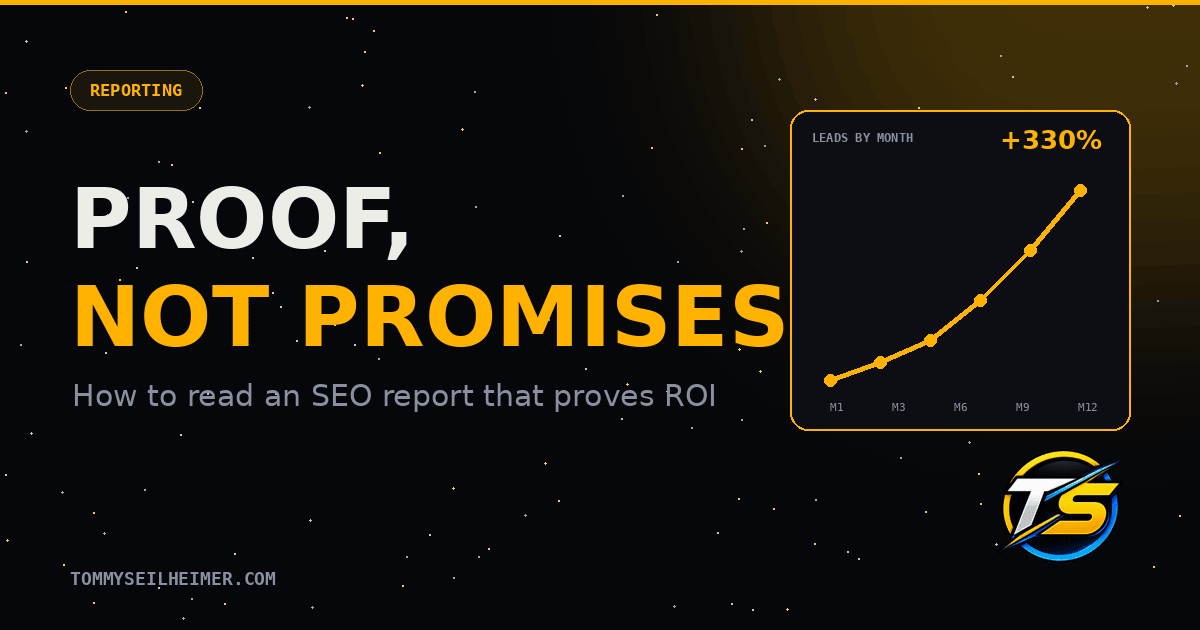 Reporting
How to Read an SEO Report: The Metrics That Prove Leads, and the Ones That Lie
Read this next if you cannot say what your SEO did last month, and you want a report that proves it.
Read the guide →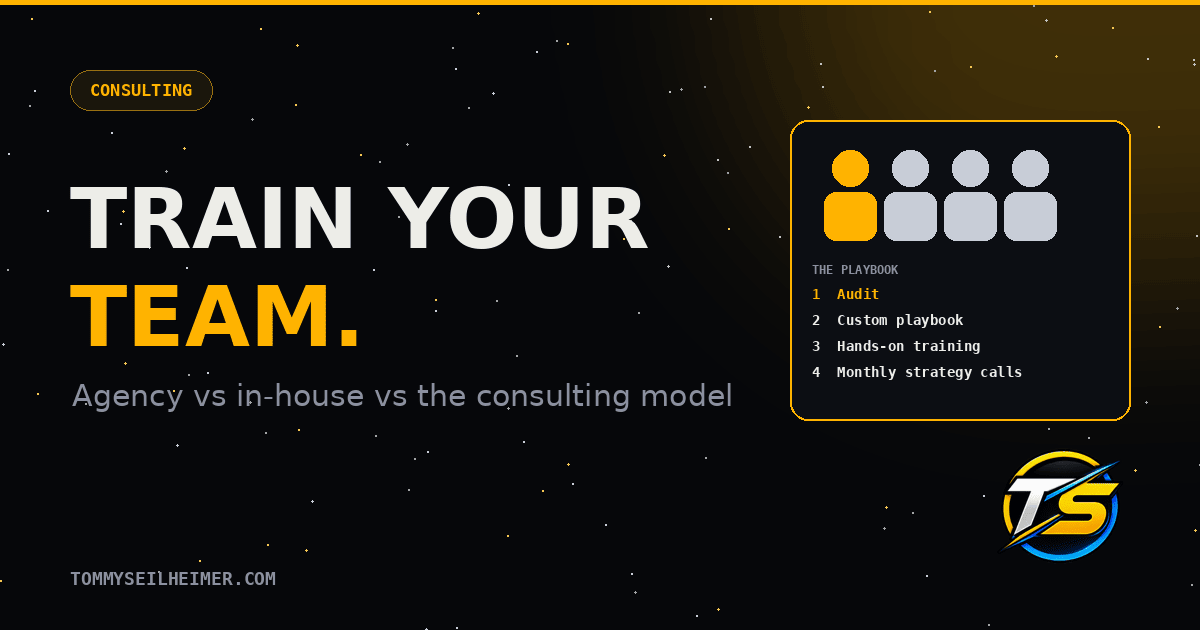 Consulting
Should You Hire an SEO Agency or Train Your Own Team? The Consulting Model, Explained
Read this next if you have a marketing team and want the method installed inside it.
Read the guide →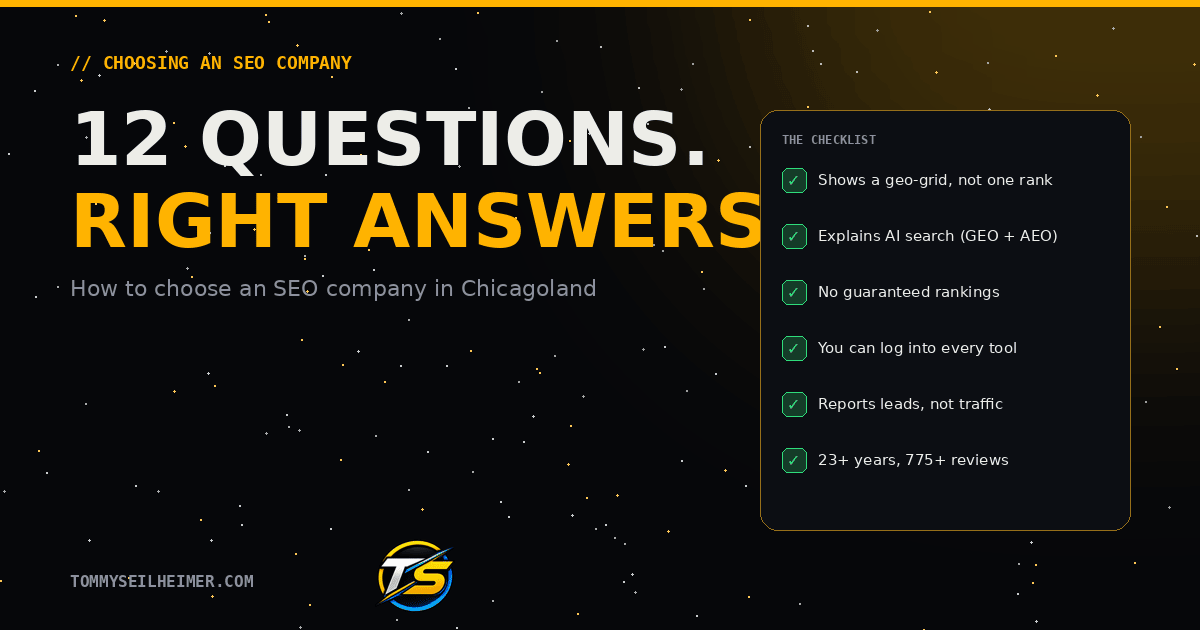 Choosing an Agency
How to Choose an SEO Company in Chicagoland: 12 Questions to Ask, and the Answers That Tell You Everything
Read this next if you are comparing SEO companies and want the questions that reveal which one will actually grow your business.
Read the guide →