What SEO Actually Involves: A Deep Dive Into How I Rank a Business
Search engine optimization is the work of making your business the clearest, most trustworthy answer for the searches your customers actually type, then proving it to Google with a fast site, complete content and real authority. It is not a bag of tricks. It is a sequence of jobs done in the right order, and most of them are invisible to the business owner paying for them.
That invisibility is the problem. Owners have been sold “SEO” that turned out to be a monthly report and nothing else. So this article opens the hood. It is the process I run on every SEO engagement, in the order I run it, with the reasons behind each step. If you have ever wondered what you were actually paying for, this is the answer.
I have done this work since 2003, for more than 220 businesses, from single-truck contractors to a global oil brand. The method below is what survived 23 years of Google changes.
What does search engine optimization mean in 2026?
SEO in 2026 means earning visibility in every place a search result appears: the classic blue links, the Map Pack, the AI Overview at the top of Google, the featured snippet, the video carousel, and increasingly the answers given by ChatGPT and Gemini. Google itself says optimizing for its AI features is still ordinary SEO, and its own SEO Starter Guide still comes down to the same fundamentals: make your site crawlable, make it fast, make its content useful and specific, and earn signals that other people trust it.
What has changed is the bar. Thin pages that once ranked because nobody else bothered now lose to complete ones. Generic content loses to specific content. And because AI answers cite only a handful of sources, being fourth is closer to being invisible than it used to be. That raises the value of doing the work properly, which is the whole point of what follows.
What happens in the first 30 days?
The first month is diagnosis, and I do not skip it even when an owner is impatient, because treating the wrong problem wastes months. Here is what the audit covers.
A full crawl of the site. Every page, every link, every redirect, every image. This surfaces broken pages, duplicate titles, orphaned content, thin pages and the technical debt that accumulates on any site older than a year.
Google Search Console and Analytics. Which pages already get impressions, which searches you nearly rank for, where clicks fall off, and which pages Google is refusing to index. Search Console is the single most underused free tool in marketing. Most owners have never opened it.
The Google Business Profile. Category, completeness, reviews, photos, and whether the information matches the website exactly. For a local business this profile often drives more calls than the site, so it is audited in the same first month. I cover the full method in my guide to optimizing a Google Business Profile completely.
Competitor gap analysis. Who is actually outranking you for the searches that matter, what they have that you do not, and where they are weak. In most local markets the winners are not spending more. They have better categories, more reviews and more complete pages.
Keyword and intent mapping. Every search worth winning gets assigned to one page, existing or planned. This map becomes the plan for the next six months.
At the end of the audit you get a written plan with priorities, not a 90-page PDF nobody reads. Then the work starts.
Which technical problems actually hold rankings back?
Technical SEO is the plumbing. When it is broken, nothing you do with content matters, because Google either cannot see the page or discounts it. These are the problems I find most often and what they do to rankings.
| Problem | What it does | The fix |
|---|---|---|
| Pages blocked or not indexed | Google cannot rank what it cannot read. Common on sites migrated from a builder. | Fix robots rules, remove stray noindex tags, submit a clean XML sitemap. |
| Slow load and poor Core Web Vitals | Hurts rankings and quietly kills conversions on mobile. | Compress images, cut scripts, cache properly, fix layout shift. |
| Duplicate titles and content | Google splits credit between copies and ranks neither. | One canonical page per topic, unique titles, consolidate or redirect duplicates. |
| Broken links and redirect chains | Wastes crawl budget and leaks authority. | Clean 301 map, remove chains, fix internal links at the source. |
| Missing or wrong structured data | Google and AI engines cannot confirm what the page is about. | LocalBusiness, Service, FAQ and Article schema, validated. |
| Weak mobile experience | Google indexes the mobile version first. If it is bad, so are you. | Mobile-first layout, readable text, tap-sized buttons. |
None of this is glamorous, which is why it gets skipped. It is also where I see the fastest early wins, because a site that has been technically broken for years often jumps as soon as Google can finally read it. When a site is too far gone to fix efficiently, I say so, and we talk about a rebuild instead of pouring money into patches.
Is something broken under the hood of your site?
Most sites I audit have at least one technical problem quietly capping their rankings. On a free strategy call I will crawl your site, show you what I find, and tell you plainly whether it needs fixing or rebuilding.
Check My SiteHow do I choose the keywords that make the phone ring?
Keyword research done badly produces a spreadsheet of 500 phrases and no strategy. Done properly, it answers one question: which searches are made by people ready to spend money with a business like yours, and which page should win each one?
I sort every search into intent tiers. Money searches are things like “emergency plumber Naperville” or “implant dentist near me”: high value, few of them, brutal competition. Comparison searches like “cost to replace a furnace in Chicago” come from people a few days from buying. Research searches like “why is my furnace short cycling” are earlier, higher volume, and perfect for the kind of content that gets cited by AI engines. A healthy plan covers all three, weighted toward the first two.
For local businesses I add the geographic layer: every service crossed with every community you serve and actually want more work from. That is why my own site has a page for every community I work in, from Chicago to the smallest villages in my service area. It is not decoration. It is intent coverage.
Then the rule that prevents most SEO failures: one intent per page. A page that tries to rank for six unrelated searches ranks for none. Each search gets a home, and each page has a job.
What does on-page optimization actually change?
On-page optimization is how a page tells Google and a reader, in the first few seconds, exactly what it is about and why it deserves to rank. The elements, in order of impact:
- Title tag. The single strongest on-page signal and the headline in the search results. Under 60 characters, the main search phrase near the front, written to earn the click, not to stuff keywords.
- Answer-first opening. The first paragraph states the answer or the offer plainly. Readers scan, Google extracts, AI engines quote. Burying the point under three paragraphs of throat-clearing costs you all three.
- Question-shaped headings. Headings that mirror how people actually ask, with the answer directly underneath. This article is built that way on purpose, and it is the core of answer engine optimization.
- Internal links. Links from your strongest pages to the ones you need to lift, with descriptive anchor text. Most sites hoard authority on the homepage and starve the pages that make money.
- Images with real names and alt text. Not IMG_4471.jpg. Descriptive filenames, compressed, with alt text a person would find useful.
- Structured data. Schema that tells machines the page is a service, a business, an article, a set of FAQs. It does not force a ranking. It removes doubt.
- Proof. Reviews, results, credentials, real photos of real people. Google calls this E-E-A-T. Customers call it trust.
Every one of these is done page by page, by hand, on the pages that matter. Bulk tools that rewrite a thousand titles at once produce a thousand mediocre titles.
Key takeaways
- SEO is a sequence of jobs in the right order: audit, technical, keywords, on-page, content, authority, measurement.
- One intent per page. A page that chases six searches ranks for none.
- Technical fixes and the Google Business Profile produce the fastest early wins.
- Content earns rankings only when it is the best available answer, written by someone who knows.
- Authority is earned from real citations, associations, partners and press, never bought.
- Report on leads and geo-grid position, not vanity traffic.
How does content build authority without becoming a content farm?
Content is where SEO budgets get wasted most efficiently. Ten blog posts a month about nothing, written by nobody, ranking for nothing. That is not a content strategy. It is a content farm, and Google has spent the last several years learning to ignore it.
What works is a small set of pages that are the best available answer for a specific question, written by someone who knows the subject. For most businesses that means four kinds of content:
Service pages that fully explain one service: what it is, who it is for, how it works, what it costs, what can go wrong, and why you. One per service, not one page listing twelve.
Location pages for the communities you serve, with real local specifics rather than a swapped city name. Thin location pages are a known Google target. Substantive ones rank for years.
Question content that answers the comparison and research searches from your keyword map, in depth, with real numbers. This is what earns featured snippets and AI citations. The guide you are reading is an example.
Proof pages. Results, reviews, case studies. They rarely rank for big searches, but they convert the traffic every other page brings in, and they are the material AI engines use to decide you are credible.
My quality bar is simple. If a page would not be worth reading if Google did not exist, it is not worth publishing.
How do I build authority and links the right way?
Authority is Google’s way of asking: does anyone besides you vouch for you? Links from other websites are still the strongest answer, and still the most abused. Bought links, link farms and guest-post schemes get sites penalized, and I do not touch them.
What I do instead is earn signals the way a real business would:
- Consistent citations. Your name, address and phone listed identically across the directories that matter for your industry and city. This is table stakes for local rankings and for AI engines confirming you exist.
- Associations and memberships. Chambers of commerce, trade associations, certifications, manufacturer dealer pages. Real, relevant, and usually ignored.
- Partners, suppliers and sponsorships. Businesses you work with, teams you sponsor, events you support. Each is a genuine link from a genuine site.
- Local press and digital PR. A real story pitched to real outlets. A hire, a milestone, a community project, expert commentary on a local issue. One good story outperforms a hundred junk links.
- Reviews everywhere they count. Google first, then the platforms your customers actually use. Reviews are a trust signal for Google, for customers, and for the AI engines that read them.
Authority compounds slowly and then all at once. It is the part of SEO that separates businesses that rank for a season from businesses that rank for a decade.
Want to know what your SEO is actually doing?
If you cannot say which searches you rank for, where you win on the map, or how many leads search sent you last month, you are not getting SEO. Let me show you what real reporting looks like.
Show Me Real ReportingHow does SEO connect to the Google Business Profile?
For any business that serves a physical area, SEO and the Google Business Profile are one system, not two. The profile decides whether you appear in the Map Pack, which takes the majority of local calls. The website decides how strong that profile is, because Google reads your site to understand what the profile represents.
So the two are optimized together: the primary category on the profile matches the main service page on the site, the services listed match the pages that exist, the address and phone match to the character, and reviews mention the services and neighborhoods the pages target. When they disagree, Google trusts neither. I walk through every field in my guide to winning the Map Pack.
How does SEO feed AI search?
Every AI citation stands on ordinary SEO. ChatGPT, Gemini and Google’s AI Overviews find sources by running searches, and they trust the sources that search engines already trust. A site with technical problems, thin content and no authority does not get cited, no matter how it is formatted.
What SEO adds on top for AI is structure: answer-first passages, question headings, self-contained sections, consistent facts and schema, plus making sure the AI crawlers are not blocked. That layer is generative engine optimization, and I explain exactly how I run and measure it in how I use EZY.ai to get businesses cited by AI. The order matters: SEO first, then GEO on top of it.
How do I measure SEO, and what do I report?
You should never have to guess whether SEO is working. I report on four things, in this order of importance:
Leads. Calls, form fills, direction requests, booked appointments. Tracked by source, so you know which came from organic search, from Maps, and from AI referrals.
Map Pack position on a geo-grid. A grid of points across your service area showing where you rank in the local results, so you see the neighborhoods you win and the ones you do not. A single rank check from one location tells you almost nothing in a dense market.
Search Console clicks and impressions for the searches on your keyword map, month over month, so you can watch pages climb before the phone catches up.
AI mentions. Whether ChatGPT and Gemini name you for the questions your customers ask, tested monthly.
All of it goes into a monthly video walkthrough, not a spreadsheet dump. That is the reporting every client gets, and it is why my clients can tell you what their SEO is doing.
How long does SEO take, month by month?
Honest timelines, because the dishonest ones are why owners get burned.
| Period | What happens | What you see |
|---|---|---|
| Month 1 | Audit, technical fixes, Google Business Profile rebuilt, keyword map and plan. | Map Pack movement often starts here. Little organic change yet. |
| Months 2 to 3 | Service pages rebuilt, on-page optimization, citations cleaned up, review system running. | Impressions rise, long-tail rankings appear, calls from Maps increase. |
| Months 4 to 6 | Location and question content published, authority building underway, first AI citations. | Competitive terms enter page one. Leads become measurable and consistent. |
| Months 7 to 12 | Expansion into more services and communities, content refreshed, authority compounding. | Top positions held, AI mentions across engines, cost per lead dropping. |
Faster is possible in a small town with weak competition. Slower is normal in a category like law or healthcare in Chicago. Anyone promising page one in 30 days is describing a term nobody searches for.
Which SEO mistakes cost businesses the most?
The mistakes I fix most often, ranked by how much money they cost:
- Buying rankings reports instead of work. If the deliverable is a PDF and nothing on your site or profile has changed, you are paying for a document.
- One page for everything. A homepage that lists every service and every city ranks for none of them.
- Ignoring the Google Business Profile. The highest-leverage asset most local businesses own, left half complete for years.
- Keyword-stuffed business names and thin location pages. Both are actively penalized now.
- Blocking AI crawlers by accident. A default robots setting quietly removes you from every AI answer.
- Chasing traffic instead of leads. A thousand visitors who never call are worth less than ten who do.
- Quitting at month three. Right before the compounding starts.
If any of these describe your situation, the fix is not complicated. It is just work, done in order. That is what I do.
Ready for SEO done properly?
Everything in this guide is what I run for clients, in this order, with reporting you can understand. Book a free strategy call and I will show you exactly where you stand and what it would take to rank.
Book My Free Strategy CallFrequently asked questions
What does search engine optimization actually involve?
How long does SEO take to show results?
What is the most important part of SEO?
Do I need new content every month?
Are backlinks still important?
How is SEO different from Google Ads?
How do I know if my SEO company is doing real work?
Does SEO help with ChatGPT and AI search?
Where to go next.
Search visibility is one system. These guides cover the rest of it.
 SEO
The SEO Foundation Every Business Needs in 2026
Read this next if you want the short version of what has to be true before any of this works.
Read the guide → AI Search
GEO vs AEO: How to Get Cited by ChatGPT and Gemini
Read this next if you want to understand how AI answers choose their sources, and why a citation beats a ranking.
Read the guide → Local SEO
How to Win the Google Map Pack in Your City
Read this next if you serve a local area and the Map Pack is where your calls come from.
Read the guide → AI Search
Generative Engine Optimization: How I Use EZY.ai to Get Your Business Cited by AI
Read this next if you want AI visibility measured and moved month by month, with screenshots.
Read the guide → Local SEO
How I Optimize a Google Business Profile Completely, Field by Field
Read this next if your Google profile is half built. This fills every field.
Read the guide → Video
YouTube SEO: How I Grew a Channel Past 243,000 Subscribers, and How Video Ranks Your Business
Read this next if you want the playbook that grew a channel past 243,000 subscribers, applied to your business.
Read the guide →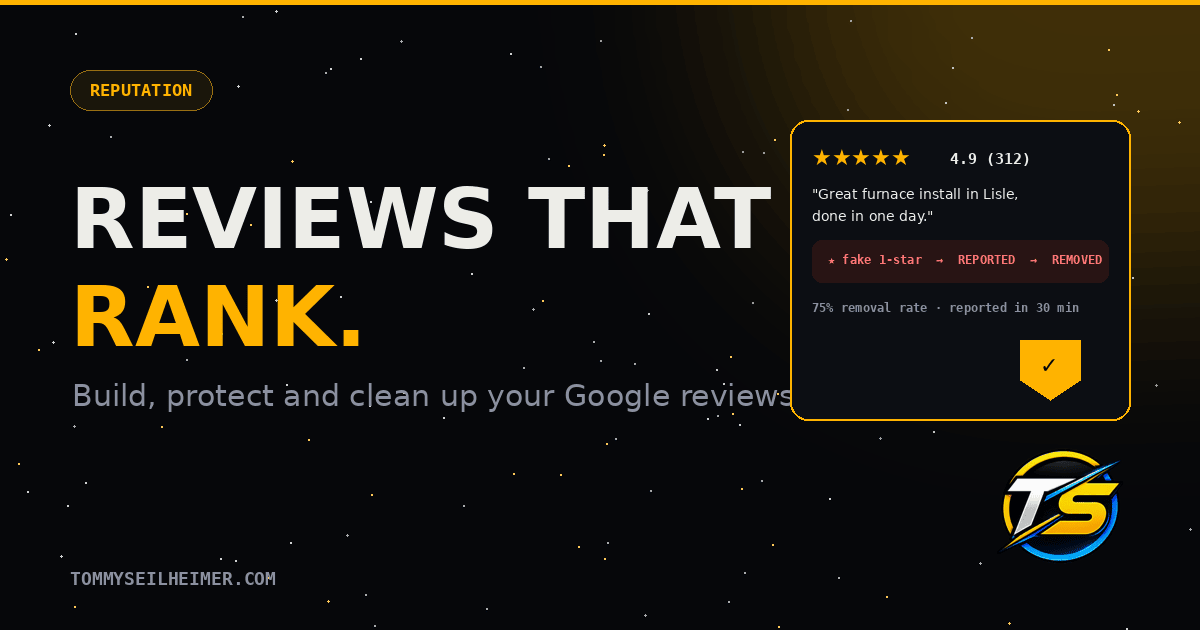 Reputation
Google Reviews and Reputation: The Complete Playbook, Including How Fake Reviews Get Removed
Read this next if reviews are your tiebreaker and you want the system that earns and protects them.
Read the guide →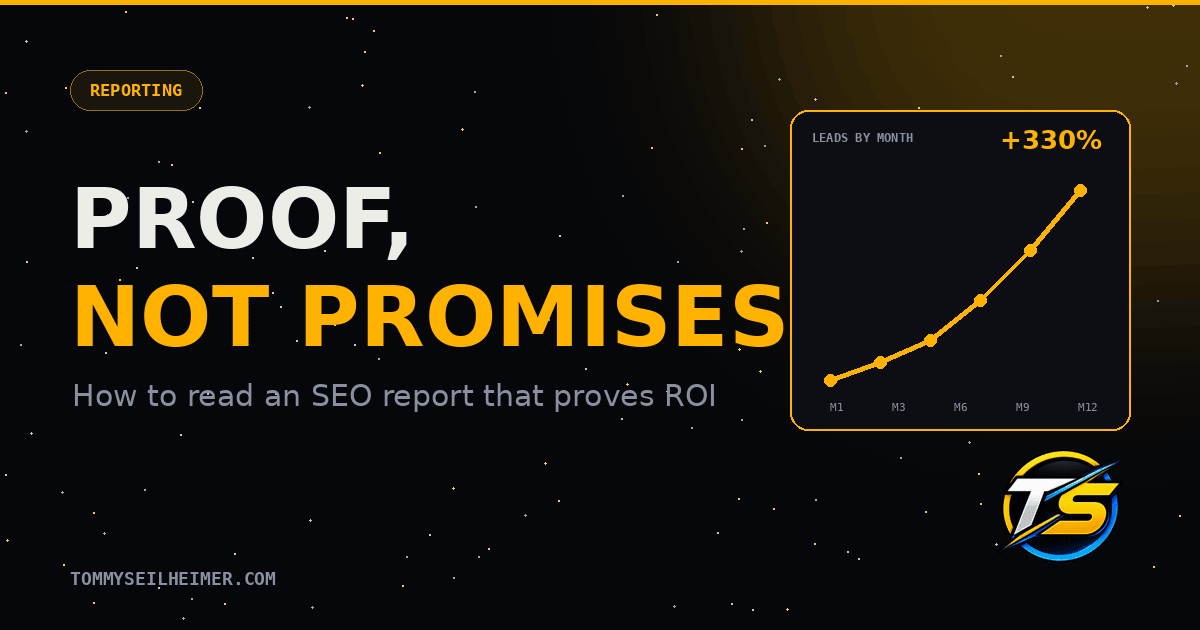 Reporting
How to Read an SEO Report: The Metrics That Prove Leads, and the Ones That Lie
Read this next if you cannot say what your SEO did last month, and you want a report that proves it.
Read the guide → Consulting
Should You Hire an SEO Agency or Train Your Own Team? The Consulting Model, Explained
Read this next if you have a marketing team and want the method installed inside it.
Read the guide →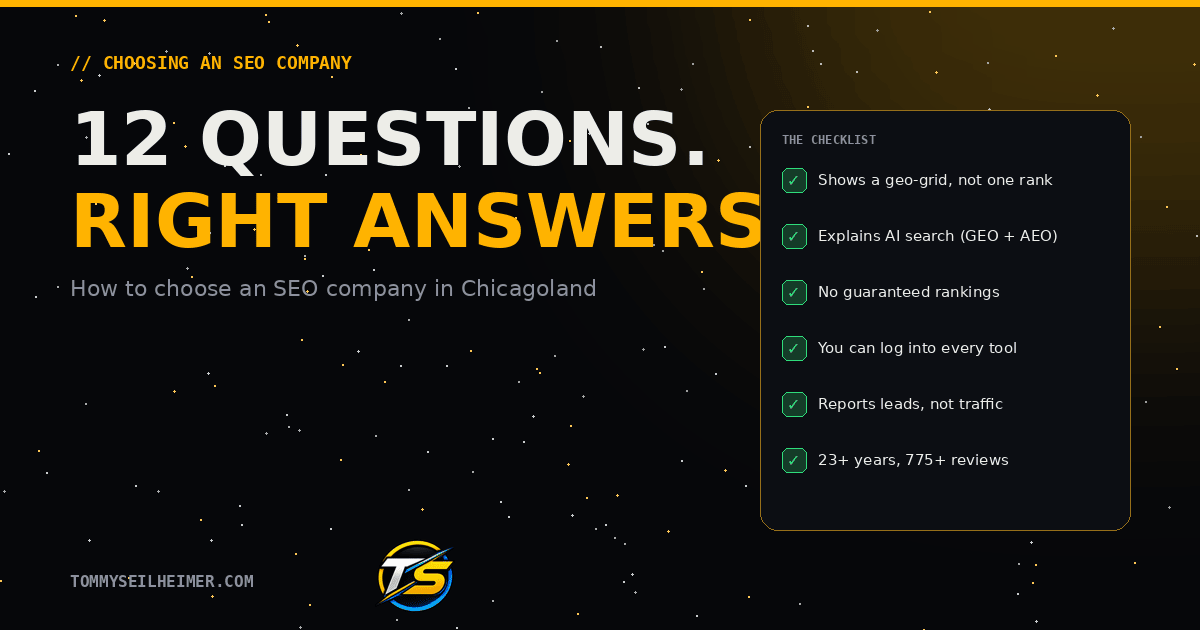 Choosing an Agency
How to Choose an SEO Company in Chicagoland: 12 Questions to Ask, and the Answers That Tell You Everything
Read this next if you are comparing SEO companies and want the questions that reveal which one will actually grow your business.
Read the guide →