How to Win the Google Map Pack in Your City
The Google Map Pack - the block of three local businesses shown with a map at the top of local search results - is the most valuable real estate in local search. Google ranks it on three factors: relevance, distance, and prominence. Master the two you can control and you win the calls in your city.
Nearly half of all Google searches carry local intent. When someone searches “plumber near me” or “dentist in [your city],” those top three results capture the overwhelming share of calls, direction requests, and visits. Everything below them is fighting for scraps.
I have been putting local businesses in the 3-pack across Chicagoland for over 20+ years. This is the complete system - what matters, in what order, and what to ignore.
What is the Google Map Pack?
The Map Pack (also called the local 3-pack or local finder) is the set of three business listings, displayed with a map, that Google shows for searches with local intent. It appears above the organic results and pulls from Google Business Profile data - not directly from your website. That single fact explains why so many businesses with beautiful websites never show up: they optimized the wrong asset.
Each listing shows your business name, star rating and review count, category, hours, and action buttons for calling, getting directions, or visiting your site. Those buttons are the point. A Map Pack listing lets a customer contact you without ever visiting your website, which is why it converts so well.
How does Google rank the Map Pack?
Google reduces local ranking to three forces, spelled out in its own local ranking documentation:
| Factor | What it means | Can you control it? |
|---|---|---|
| Relevance | How well your business matches what was searched | Yes - heavily |
| Distance | How close you are to the searcher | No |
| Prominence | How well-known and trusted your business is | Yes - over time |
Dozens of individual signals feed into those three buckets. The practical takeaway is simple: stop worrying about distance and pour everything into relevance and prominence. That is how a well-run business beats a bigger, closer competitor.
Factor 1: Your primary category
This is the single most influential local ranking factor, full stop. Your primary Google Business Profile category is the main relevance filter Google applies - if it does not match the searcher’s intent, you frequently are not even in the candidate set, no matter how good everything else is.
How to choose the right one
Pick the most specific category that describes your core business - the service that makes you the most money and that you most want to be called for. Not the broadest one, and not an aspirational one. If you are primarily a roofer who also does gutters, your primary is Roofing Contractor, with gutters as a secondary category.
How to find what actually works
Search your money keyword in an incognito window from your target area and look at which businesses rank in the 3-pack. Their primary category is visible on their profile. If the top three all share a category and you have a different one, that is very likely your problem. I have moved businesses several positions in a matter of weeks by fixing nothing but this.
Secondary categories
Add secondary categories for every legitimate service you provide, but do not stuff the list with loosely related ones. Irrelevant categories dilute your relevance and can trigger quality issues. Be thorough and be honest.
Category quick check
- Does your primary category match what the current 3-pack winners use?
- Is it the most specific accurate option, not the broadest?
- Does it reflect your highest-value service, not a side offering?
- Are your secondary categories all genuinely services you provide?
Factor 2: Reviews and review velocity
Reviews are one of the heaviest prominence signals - but the nuance matters, and most businesses get it wrong.
Velocity beats total count
A steady, ongoing flow of recent reviews outperforms a large pile of old ones. A business with 90 reviews earning six a month typically outranks one sitting on 400 reviews from three years ago. Google reads recency as evidence that you are active and currently serving customers. Consistency is the whole game here.
Aim for quality, not perfection
A 4.5 to 4.9 average is the sweet spot. A flawless 5.0 with hundreds of reviews can actually read as suspicious to both Google and customers. A few thoughtful negative reviews with professional responses make the rest more believable.
Review content feeds relevance
This is the underrated part. The words customers use in reviews help Google understand what you do and where. A review that says “they replaced our water heater in Naperville and were on time” is worth far more than “great job.” You cannot script reviews - that violates the guidelines and customers can tell - but you can ask better questions. Instead of “please leave a review,” try “if you have a minute, it really helps if you mention what we did and how it went.”
Build a system, not a scramble
The businesses that win at reviews have a repeatable process: ask at the moment of peak satisfaction, make it one tap with a direct link, follow up once, and respond to every single review within a couple of days. Never incentivize reviews with discounts or gifts - that violates Google’s policies and can get reviews stripped or your profile flagged. My reputation management service exists to run exactly this system for clients.
Factor 3: Profile completeness
Most businesses use less than half of what Google Business Profile offers, then wonder why they lose to a competitor who filled everything in. Every field is another signal Google can match against a search.
- Business description - explain what you do, who you serve, and where, in natural language.
- Services - list every service individually with its own description. This is one of the highest-value and most-skipped fields.
- Products - use it if relevant; it adds surface area and visual appeal.
- Attributes - accessibility, payment types, appointment options, business identity attributes. Many map directly to search filters.
- Hours - accurate, including holidays. Wrong hours frustrate customers and hurt trust.
- Photos - real photos of your team, work, vehicles, and location. Add them regularly rather than once.
- Q&A - seed the common questions and answer them yourself. Unanswered questions can be answered incorrectly by strangers.
- Posts - regular updates signal an active business and occupy more space in your listing.
- Booking and messaging - enable where it fits; they drive the actions Google measures.
Getting this right, and keeping it right, is the core of my Google Business Profile work.
Why is that competitor above you?
Nine times out of ten it comes down to something boring and fixable - a mismatched category, stale reviews, or business details that disagree across the web. I will find yours.
Find Out Why They RankFactor 4: NAP consistency and citations
Google cross-references your profile against the wider web. Your name, address, and phone number - NAP - should be byte-for-byte identical everywhere it appears: your website, Google, Bing Places, Apple Maps, Yelp, industry directories, chambers of commerce, and social profiles.
Inconsistencies are more common than you would think: an old suite number, a tracking phone number on one directory, “St.” on one and “Street” on another, or a duplicate listing from a former location. Each one chips away at confidence. Audit them, fix them, and get any duplicate listings merged or removed. This is unglamorous cleanup work that quietly moves rankings.
Factor 5: Your website’s local signals
Your Google Business Profile drives the Map Pack, but your website reinforces it - and it is where conversions actually happen.
- Location and service-area pages with real substance. A genuinely useful page for each area you serve, not a thin template with the city name swapped. Thin, duplicated city pages are a well-known risk and can do more harm than good.
- Full NAP in your footer and on a clear contact page, matching your profile exactly.
- LocalBusiness schema markup stating your details as structured facts.
- Embedded map and clear directions on your contact page.
- Local relevance in your content - genuine references to the areas, landmarks, and communities you serve, written naturally.
- Fast, mobile-friendly pages, since most local searches happen on a phone.
All of this rests on the broader fundamentals covered in the SEO foundation every business needs in 2026, and it is what my SEO and website design work is built around.
Factor 6: Behavioral signals
Google watches how people interact with your listing. Calls, direction requests, website taps, photo views, and bookings all indicate that searchers find you compelling. Listings that earn more of these actions tend to hold and improve their positions.
You influence this by being the most clickable option: a strong review rating, appealing recent photos, complete information, accurate hours, and posts that give people a reason to engage. It is a feedback loop - a better listing earns more actions, which reinforces the ranking, which produces more actions.
Want your Google Business Profile audited?
I will go through your profile field by field, compare it against the businesses currently holding your 3-pack spots, and hand you the gaps. No pitch, no obligation.
Audit My ProfileBeating proximity: what to do when you are not closest
Proximity is the factor you cannot change, and it frustrates everyone. You cannot move your building, and Google will often favor a closer competitor for someone standing next to them. But proximity is weighted differently depending on the query and the density of options - and it is not absolute. Here is how you win anyway:
- Dominate relevance. Exact-match primary category, complete services list, and content that unmistakably matches the search.
- Out-prominence them. More recent reviews, stronger citations, more genuine local presence and mentions. Prominence is where a determined business beats a lazy incumbent.
- Target the searches where you can win. If you cannot win “plumber near me” downtown, win the specific service terms - “sewer line repair,” “sump pump replacement” - where fewer competitors are properly optimized.
- Build genuine local relevance in each area you serve with real, substantive pages and real local involvement.
- Expand your footprint honestly - if you legitimately operate from an additional location, a properly staffed one can be listed. Fake addresses and virtual offices get profiles suspended, and I have cleaned up that mess for too many businesses to recommend it.
Service-area businesses vs storefronts
If customers come to you, you have a storefront listing with a visible address. If you travel to customers - contractors, mobile services, home services - you should be configured as a service-area business, which hides your address and defines the regions you cover.
Service-area businesses face a harder road because Google anchors your listing to your registered location regardless of your stated coverage. The countermeasures are the same, applied harder: exceptional relevance, strong review velocity mentioning the areas you serve, substantive pages for each area, and real local presence. Do not list areas you do not actually serve, and do not create fake locations to game proximity - suspension is a real and expensive outcome. If you are already suspended, that is exactly what my GBP reinstatement service handles. I also build dedicated service-area pages for the communities my clients actually serve.
Multi-location businesses
Every physical location needs its own Google Business Profile with its own phone number, its own hours, and ideally its own manager. On your website, each location needs a dedicated page with unique content, that location’s NAP, its own schema markup, and details specific to that branch - staff, service specifics, local landmarks, parking. Do not duplicate the same page with a swapped city name. Reviews should be collected per location, since they attach to individual profiles.
Key takeaways
- The Map Pack ranks on relevance, distance, and prominence - focus everything on the two you control.
- Your primary category is the number-one factor. Match what the current winners use.
- Recent reviews beat old reviews, and review wording feeds your relevance.
- Fill in every profile field - most competitors do not.
- Keep NAP identical everywhere and eliminate duplicate listings.
- Never fake locations or incentivize reviews - suspension costs far more than it gains.
Mistakes that get you outranked (or suspended)
- Keyword-stuffing your business name. Adding “Best Chicago Plumbing” to a name that is not legally that is a guideline violation and a common suspension trigger. It also gets reported by competitors constantly.
- Using a virtual office or a relative’s address. Google is good at catching this now.
- Buying or incentivizing reviews. Reviews get stripped and profiles get flagged.
- Letting the profile go stale. No new photos, no posts, no recent reviews reads as a business winding down.
- Ignoring negative reviews. A professional, non-defensive response often matters more to readers than the complaint itself.
- Duplicate listings. They split your signals and confuse Google. Find and merge them.
- Wrong or missing hours. Frustrates customers and undermines trust.
- Thin, duplicated city pages. Templated pages with only the city name changed can be treated as low-value. Give each one genuine, specific substance.
How to track your Map Pack rankings
Your own searches lie to you. Google personalizes results based on your location, history, and device, so checking from your office tells you almost nothing about what a customer across town sees.
- Use a geo-grid rank tracker that checks your position from many points across your service area. Local rankings vary block by block, and a grid shows you exactly where your visibility fades.
- Watch Google Business Profile Insights for calls, direction requests, website clicks, and the searches that surfaced you.
- Track calls and forms by source so you know what the rankings are actually producing.
- Monitor review velocity and rating as a leading indicator.
Transparent tracking on all of this is built into my detailed reporting, because you should never have to take a ranking claim on faith. You can browse real client results and reviews to see what that looks like in practice.
Your 60-day Map Pack action plan
- Week 1: Audit your primary category against the current 3-pack winners and fix it. Claim and verify your profile if you have not.
- Week 2: Complete every field - services with descriptions, attributes, hours, business description, booking links.
- Week 3: Add 15 to 20 real photos. Seed and answer your Q&A. Start posting weekly.
- Week 4: Audit NAP across every major directory. Fix inconsistencies and merge duplicates.
- Weeks 5-6: Launch a repeatable review request process and respond to every existing review.
- Weeks 7-8: Build or rewrite your location and service pages with genuine local substance, add LocalBusiness schema, and set up geo-grid tracking to measure it.
Do those eight weeks properly and you will see movement. I have run this exact sequence for a waterproofing company that was nearly invisible in local search - they went from “the phone only rings when it rains” to the top spot across the western suburbs, with Google Business Profile calls up more than 330% year over year. Nothing exotic. Just the fundamentals, executed completely, in the right order. If you want that run for your business, book a strategy call or see how my Google Business Profile service works.
Ready to take a 3-pack spot?
Three spots, and they are already taken by somebody. Book a free strategy call and I will show you exactly what those businesses are doing that you are not - and how long it takes to pass them.
Book My Free Strategy CallFrequently asked questions
What is the Google Map Pack?
What is the number-one local ranking factor?
How many reviews do I need to rank in the Map Pack?
Why does a competitor with fewer reviews outrank me?
Can I rank in a city where I do not have an office?
How long does it take to rank in the Map Pack?
Does my website affect my Map Pack ranking?
What gets a Google Business Profile suspended?
Should I be a service-area business or show my address?
Where to go next.
Search visibility is one system. These guides cover the rest of it.
 SEO
The SEO Foundation Every Business Needs in 2026
Read this next if you want the short version of what has to be true before any of this works.
Read the guide → AI Search
GEO vs AEO: How to Get Cited by ChatGPT and Gemini
Read this next if you want to understand how AI answers choose their sources, and why a citation beats a ranking.
Read the guide → SEO
What SEO Actually Involves: A Deep Dive Into How I Rank a Business
Read this next if you want the full SEO process, step by step, in the order I actually run it.
Read the guide → AI Search
Generative Engine Optimization: How I Use EZY.ai to Get Your Business Cited by AI
Read this next if you want AI visibility measured and moved month by month, with screenshots.
Read the guide → Local SEO
How I Optimize a Google Business Profile Completely, Field by Field
Read this next if your Google profile is half built. This fills every field.
Read the guide → Video
YouTube SEO: How I Grew a Channel Past 243,000 Subscribers, and How Video Ranks Your Business
Read this next if you want the playbook that grew a channel past 243,000 subscribers, applied to your business.
Read the guide → Reputation
Google Reviews and Reputation: The Complete Playbook, Including How Fake Reviews Get Removed
Read this next if reviews are your tiebreaker and you want the system that earns and protects them.
Read the guide →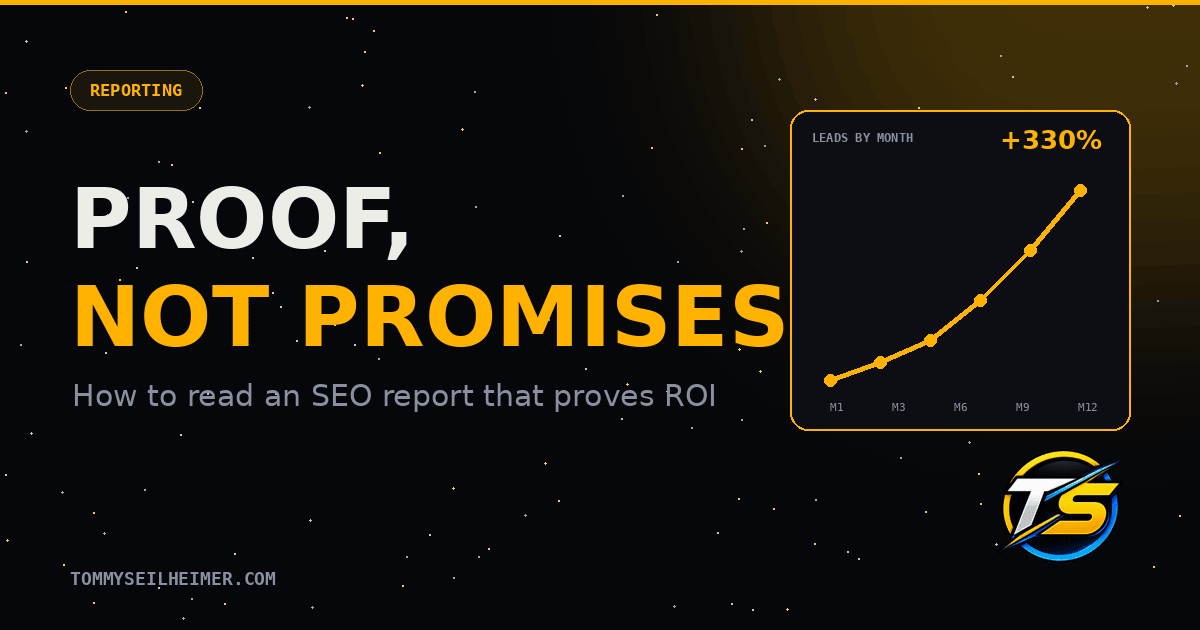 Reporting
How to Read an SEO Report: The Metrics That Prove Leads, and the Ones That Lie
Read this next if you cannot say what your SEO did last month, and you want a report that proves it.
Read the guide → Consulting
Should You Hire an SEO Agency or Train Your Own Team? The Consulting Model, Explained
Read this next if you have a marketing team and want the method installed inside it.
Read the guide →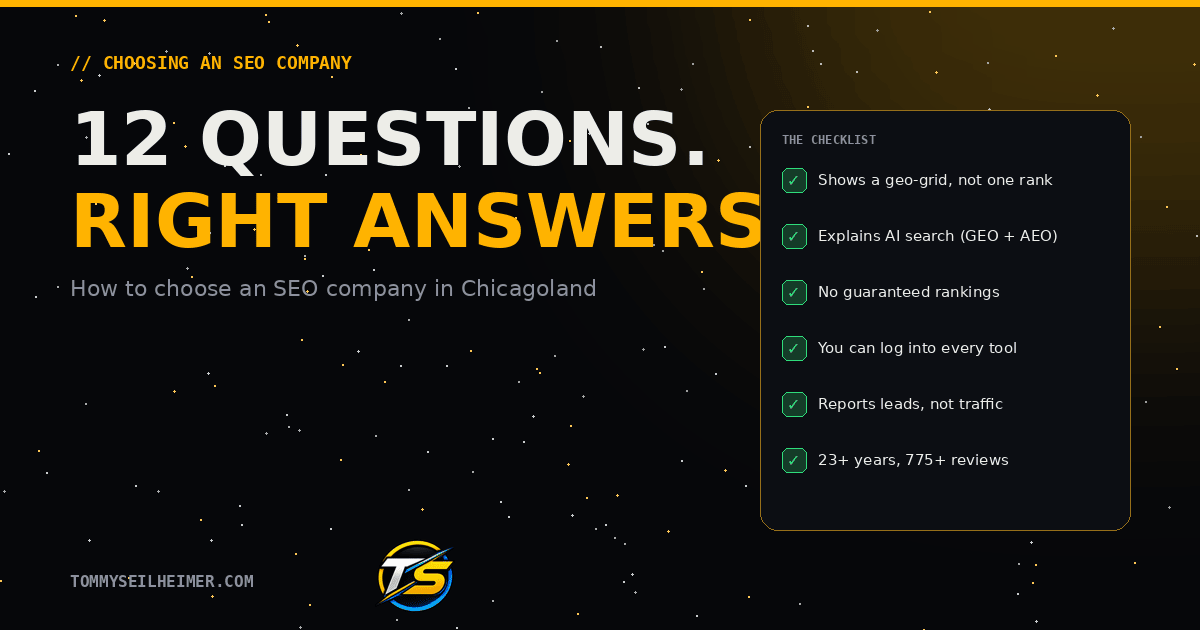 Choosing an Agency
How to Choose an SEO Company in Chicagoland: 12 Questions to Ask, and the Answers That Tell You Everything
Read this next if you are comparing SEO companies and want the questions that reveal which one will actually grow your business.
Read the guide →